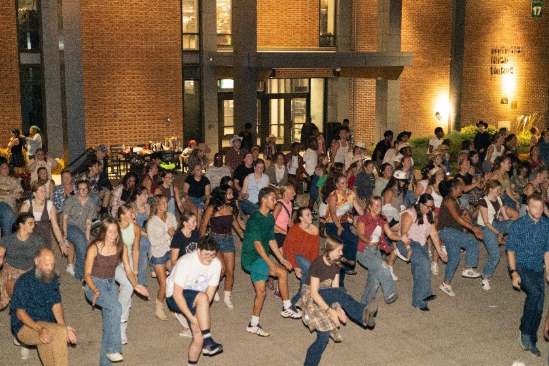
Directors, Crew, and Actors Provide an Inside Look into Junior Student Films Eau de Fin and Broke Boys.
By Ellen Batty | March 30, 2026
At 1:00 a.m., two students sprinted down the quiet Heim Street dressed in black ski masks–laughter and banter cutting through the cold air as cars slow in confusion. Hours earlier, another group of students set up a faux perfume shop, in which customers are invited to enjoy the scent of how they’re going to die.
While these two incidents seem bizarre and unexplainable, they’re actually key scenes in two of Huntington University’s Junior films–Maya Oyer’s Eau de Fin and Scotty Frank’s Broke Boys.
If given the choice to find out how you die, would you take it? And how far are you willing to go for money?
Though vastly different in tone, Eau de Fin and Broke Boys tackle questions like these, using both existential themes and chaotic humour to portray a compelling story reflecting the unpredictability of life. Behind the scenes, they also reveal the creativity, collaboration, and heart required for student filmmakers to bring bold ideas to life and why the arts are so important to protect.
Each year, Huntington’s film program gives students across all years the opportunity to pitch original short films— with only a few chosen for full production. From there, student crews are assembled, money is fundraised, and an entire, original production is created.
Eau de Fin
Eau de Fin follows a chronically anxious man who encounters a magic perfume that reveals how a person will die based on its scent. Driven by his fear of death and curiosity, the man wrestles with whether to try the perfume or remain oblivious to how his life will end.
“I came up with the idea for the story, I think about a year ago,” said director Maya Oyer. “I remember just laying in bed, and I just had this . . . flash of . . . imagine that there was a perfume that . . . smelled like how you were gonna die.”
After finalizing the story, Oyer brought her idea to the student film pitch process—which it was selected to be produced into a full short film.
“I hope that viewers can kind of put themselves in the shoes of our main character, Bert,” Oyer said. “Because we all have fears about the unknown. We all, I think, in a way, kind of fear death.”
Throughout the film, Bert wrestles with the perfume—debating on whether he should take a sniff and learn how he will die or have his cause of death remain a mystery. His journey becomes less about the perfume itself and more about how he chooses to respond to his fear of death.
“I’m not trying to like change anyone’s life with this movie,” Oyer explained, “but I hope that it gives the viewer something to think about, and maybe they feel the same things that Bert does at the end of the movie, and they choose to go about their life with feeling a little more freedom than maybe they did before, and not being afraid of not letting their anxieties control them.”
At the end of the film, the focus turns from fear to acceptance—learning that peace does not come from knowing the future but rather choosing to live in the present—as God intends.
“I definitely took . . . a lot of . . . my own . . . faith and put it into this film,” Oyer said. “I think anyone from any background can kind of look at this story . . . but . . . I think that a Christian viewer could take a little more from it.”
Rather than explicitly stating this message, Eau de Fin allows these themes to exist under the surface, inviting viewers to interpret the meaning through their own experiences.
Assistant producer Faye Satterthwaite adds, “We shouldn’t fear death as Christians, because death is move on upwards towards him. It shouldn’t be a bad thing that we pass away, but a lot of people do fear death . . . We should be relying in God instead of fearing the outcome.”
Producer Emmy Malone states the key takeaway is “knowing that there’s more to life than being afraid of everything.”
From the beginning, the project drew in other filmmakers who believed strongly in the film’s potential.
“I was like, if I don’t get chosen, I want to work on [Eau de Fin] because it will get chosen,” said Michael Hill, the gaffer, who was also pitching that day.
Pitch day is where creative ideas compete for a chance to be turned into a production. For film students, this day brings a lot of anxiety with its uncertainty—much like the themes reflected in Eau de Fin, where the main character struggles with anxiety about the uncertainty of his death.
“Part of the mystery of life is not knowing when it might not be around anymore,” Hill said.
The idea of uncertainty became central to not only the narrative of Eau de Fin, but also to the way it was visually constructed. Instead of trying to explain each scent in verbal or literal terms, the team leaned into an abstract interpretation—playing with lighting to portray the different scents. One of the most defining creative decisions came from an unexpected source of inspiration.
“There’s a scene where he . . . takes a bite of cheese and then you see the swirls behind him of him like tasting it,” Hill said, referencing Disney’s Ratatouille, “I was like, what if we did a version of that where when he smells it, there’s colors that come up to indicate what he’s smelling?”
What began as a simple visual reference quickly evolved into a central element of the film—one that would shape how audiences understood Bert’s internal experience. Instead of telling viewers what the scent meant, the film shows it, using lighting to communicate something that words don’t capture.
“So when you go closer to your subject with the camera, the light will bend like a curve around the lens,” Hill explained. “So then I hit two lights off center, . . . off the sides, and it made big circle effects like could like flash behind and . . . kind of spin around the character as they smell.”
Through experimentation with lighting placement and camera distance, the team was able to create a visual for the scents of the perfume that felt intentional and surreal.
“Lighting is the makeup of movies,” Hill states.
Director of photography Nick Webb expanded on the technical side of the production, describing how specialized equipment Huntington provides for its students contributed to the final look.
“We rented out this special lens called the Petzval lens. It has this curved bokeh effect, which is just . . . the stuff that’s not in focus in the background,” Webb said. “Anytime he would sniff the perfume, he would go into . . . this other state . . . and depending on what the smell was, it would change . . . the colors.”
With the lighting and camerawork combined, these effects do more than add aesthetic appeal–they place the audience directly inside Bert’s experience, allowing them to feel the same wonder and intrigue of the different scents.
“We got this really cool shot where it was from outside the window,” Webb said. “It’s one of my favorite things in movies . . . natural framing . . . A-frame inside of A-frame . . . it shows he’s . . . disconnected from himself.”
This layering of visuals adds another meaning to the film. For Webb, it’s decisions like these that capture the true power of filmmaking.
“When you draw a picture . . . it’s like a picture captures a thousand words, but a moving picture, how many words does that capture? Probably like a bajillion.” He states.
While the visuals ended up beautiful, they were only made possible because of the people behind them.
“You learn all this stuff and then . . . put that in like new people . . . and they come up with ideas you never would have had,” Hill said.
As gaffer, he led the grip and electric team, helping to turn creative ideas into intentional lights placed, angles tested, and other adjustments.
“It’s going to sound cheesy,” he said, “but… it was literally a dream team.”
Nick Webb described a similar dynamic. “We were the trifecta . . . we just understood each other.”
This kind of collaboration didn’t eliminate challenges, but it did make them possible to overcome.
“Saturday was really stressful, but it was efficient,” Webb said.
Producer Emmy Malone experienced that pressure firsthand. “It was a whole circus in itself.”
At one point, the filming was nearly stalled. “We lost our first location… we didn’t get the new one until the week before. That was terrifying.”
Still, humor was able to be found among the chaos. Malone notes to avoid having people interrupt film, “You tell people it’s a mayonnaise commercial,”
Moments of this lightheartedness become just as important as the film itself—building a community behind the hard work. On the set of Eau de Fin, one of those moments came in the form of an unexpected game that quickly became a favorite among the crew.
“Everyone’s just like . . . you gotta check me for clothes pins. Got back of shoes. Oh, those were good ones,” said production designer Emily Karcher. “And . . . I would always get people in their hair. They whack themselves in the face with it.”
The clothespin game is where crew members secretly attach pins to one another without being noticed. This became a small but memorable part of the filming process. Between takes, students weren’t just focused on lighting setups or camera angles; they were laughing, joking, and finding ways to make the long days feel lighter while avoiding getting pinned.
These moments, while seemingly small and pointless, played a significant role in shaping the atmosphere on set. They created a sense of community, reminding everyone involved that filmmaking is not just about the final product—it’s about the experience of creating something together.
That sense of shared joy and connection is something many students pointed to as one of the most meaningful parts of the process.
Broke Boys
Broke Boys is a comedy that follows two teenagers, Mark and Keith, whose attempt to solve their financial problems leads them into absurd and questionable situations.
“It’s like teenage humor . . . awkward . . . kind of like Superbad,” said director Scotty Frank.
But beneath the humor, there’s something to reflect on.
“It’s funny, but it’s not surface level . . . you can’t control the circumstances of your life . . . the more you try . . . the less control you actually have.”
As the story unfolds, the audience begins to understand the deeper motivations behind the characters’ actions.
“We realize Mark has some real deep issues,” Frank said.
Actor Micah Gilliom explained, “My character lost his dad . . . and that influences everything.”
For Frank, directing the film came with an unexpected challenge.
“I had pneumonia while we were filming.” Despite exhaustion, he stayed committed and powered through filming. “It was worth it. I would do the same thing again.”
Frank notes the sickness’s effect on him “I don’t remember anything from set. I was so sick.”
Despite this, the team’s energy carried the project forward. “Everyone came in with a smile… we were all laughing.”
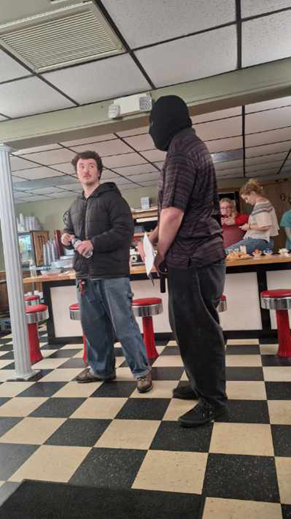
Much of Broke Boys humor thrives on spontaneity, absurdity, and friendly banter between the characters.
“We riffed . . . it brought out genuine humor,” Gilliom said.
“We were in ski masks at 1 a.m. . . . it looked so bad,” he added, laughing.
While Broke Boys comes across as spontaneous and chaotic on screen, the process behind creating the film was anything but accidental. Like all junior films, it began long before cameras started rolling—with an idea that had to be shaped, challenged, and rebuilt over time.
“I wrote this film my freshman year of college and I sat on it because I wanted to direct it, but I didn’t know when,” said Frank. “I was going to do it as a passion project . . . but I decided I needed funding to actually make it happen.”
That waiting period proved essential to Frank. When revisiting the script years later, he saw it with a new perspective.
“So I waited and this year I revisited the script and I read it and I was like, this is horrible,” he said. “So I literally deleted the whole thing, but I liked what the concept was and I just rewrote the whole script this year for the junior films.”
What remained was the heart of the story—something created not in the outrageous situations the characters find themselves in, but in real, lived experience.
“It was also really inspired by . . . my teenage years . . . being overly confident and finding myself in situations that are stupid and just running around with good friends,” Frank said.
Once the script was finalized and approved, the focus shifted to pre-production—a stage that required careful planning and communication.
“Before the film, it’s a lot of just answering questions, trying to make sure your team is lined up on the path that you need them to be on,” Frank explained. “Making sure that everyone . . . is on the same page or else it’s not a cohesive unit of a film.”
To make that happen, the team met regularly, building not just a plan, but creating a shared understanding of the film’s tone and goals.
“Beforehand we had crew meetings . . . weekly crew meetings,” Frank said. “And everyone just came in with a smile . . . we were all laughing and excited . . . getting on the same page.”
That foundation of communication became especially important once filming began—particularly given the film’s unique humor angle.
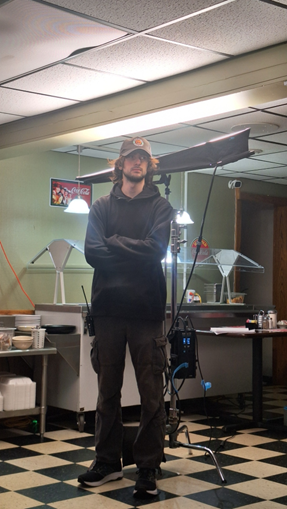
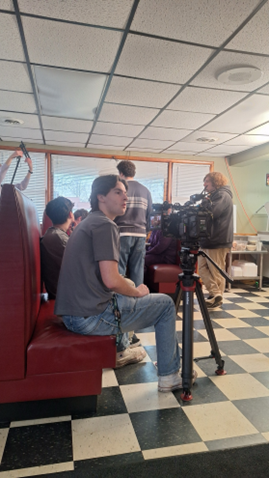
Much of Broke Boys relies on natural, conversational humor, something that can’t always be scripted word-for-word. Instead, actors were encouraged to find banter and relationship between their characters through flexibility and improvisation.
“Some of the scenes were . . . kind of like bicker back and forth,” said actor Micah Gilliom. “We memorized like the overall gist of it sometimes, but it was kind of . . . riffed and . . . impromptu . . . which is really fun.”
“Scotty wanted that in his film too,” he added. “He wanted us to be able to be flexible and just like feel natural . . . it brought out the genuine humor.”
That approach required a different kind of trust—not just in the script, but in the people bringing it to life.
“The whole film was kind of . . . between their . . . bond . . . and also family elements,” Gilliom said.
Even technical challenges became opportunities for creativity. In one scene, the team needed to simulate a moving car without actually filming on the road.
“Basically, what we did is we put Scotty, the director’s car, inside the barn and put a projector behind it,” Gilliom said. “And we like blacked out all the windows… so it looked like we were driving.”
For actor Joe Finch, who had little prior experience in acting, the process itself was part of the appeal.
“I think I like, I helped people rehearse . . . but I wasn’t in anything,” he said.
That quickly changed once he stepped onto set, with Finch’s character becoming a key component to the film and its humor.
“They put me in a silly outfit for one scene and I was kind of just . . . hamming it up . . . people were getting a kick out of seeing me just . . . being weird. That was fun.”
Even beyond performance, the filmmaking process offered something deeper: a new way of understanding storytelling itself.
“It’s kind of like they say you have to be . . . reading and writing go hand in hand,” Finch said. “I think making movies and watching them goes more hand in hand than you might expect.”
For Frank, that understanding is part of what makes film such a powerful career field to pursue.
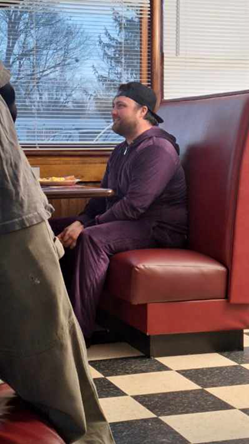
“And outside of just like how to use the lights and how to use the camera,” he said, “you learn how to . . . read people . . . how to embrace different perspectives and ideas.”
That learning extends far beyond any single project.
“And even now, I’m still not 100% sure where I’ll be in even a year,” Frank added. “But I know that I will never regret coming to film school . . . and learning the things that I have learned.”
Why Art Still Matters
For many of the students involved in both Eau de Fin and Broke Boys, the experience of filmmaking extended far beyond technical skills or completed scenes. It became a space where creativity, connection, and personal expression came together—something that many feel is increasingly undervalued.
“The creative world is fighting between the people who pay for creative stuff and the actual creatives,” said Michael Hill. “It’s sacrificing . . . an actual creative vision for . . . ease of marketing . . . it sacrifices something that could make a movie better.”
Hill pointed to a shift in how art is perceived.
“And it breaks my heart because I feel like the world was a lot better off when art was considered . . . high praise,” he said. “But art has slowly become a . . . taboo in the world where if you tell someone you do art for a living, they’re like, oh, so what’s your real job?”
Looking to the past, he emphasized how differently creativity was once valued.
“This is a really, really extreme example, but in like the Renaissance days, painters would take months, sometimes years . . . and they’d get paid the entire time . . . buildings used to be an art form . . . but now . . . your job is only as good as how high level an artist you are.”
Despite these societal changes, students across both films expressed a shared belief: that creativity and personal gifts are not reserved for a select few—it is something everyone possesses.
“Even people who are like doing nursing or business or finance or agriculture . . . you have something you can do uniquely you,” Hill said. “And I think that that’s a gift and that’s beautiful and you should pursue it.”
This belief was echoed by Frank, “Creating shouldn’t be limited to the rich,” he said. “It’s something that pushes us all to be better people and for us all to like gain perspective and different experiences.”
For many, filmmaking also became a way to connect—with stories, with audiences, and with each other.
“I think that the arts as a whole are so important to protect because it allows the people who are more artistically minded to find their communities and find a sense of belonging,” said Oyer. “I know for myself . . . I have met just the greatest people through this program . . . best friends that I will know for the rest of my life.”
That sense of belonging extended beyond those pursuing film as a career.
“For the artists, it gives us a chance to express ourselves and connect with people in that way,” Oyer said. “And then for the people who maybe aren’t as artistically minded . . . they get to be involved in this thing that they wouldn’t normally get to be a part of . . . it really does become like a mini community.”
Karcher shared a similar perspective.
“I kind of want to create something that . . . could bring this sense of unity with people,” she said. “I want to make people feel like seen and understood with movies.”
“Please always support the arts,” she added. “Movies are something that can really bring people together . . . we had a huge Oscars watch party . . . just a group of people… really passionate about the same things.”
“We can’t do what we do without support in a community for people who want to enjoy it.”
For actors like Joe Finch, the impact of filmmaking is just as much about participation as it is about performance.
“I think being a part of like a creative endeavor like that is like, there’s something enriching about that,” Finch said.
“A lot of people can get involved… even if you’re not in a film program… you get a peek into the world.”
“If some 19 year old kid asks you to be in a movie, just probably say yeah,” he added. “Because it’s fun. It’s good to try new things.”
That willingness to try, create, collaborate, and to step into something new is what continues to drive the student filmmakers in their filmmaking pursuits.
“We’re in a time where art is very easy to create, but it’s also . . . very difficult for our generation to actually put pen to paper,” Frank said.
And yet, the film students do it anyways.
They write the scripts, bravely pitching their ideas. They stay up late, often pulling all-nighters, to adjust lights, run lines, solve problems, edit, and start over when things fall apart—all for the endeavor of creating something new.
Because for them, filmmaking isn’t just an academic assignment—it’s something deeper.
“I’ve always loved storytelling . . . and I fell in love with it,” Frank said.
In the end, filmmaking is never the work of just one person.
“I mean, you sit in the theater after the movie’s over and you watch the credits roll . . . sometimes it’s like an extra 15 minutes of just names,” Finch said. “That alone is just like a proof of how collaborative it really is.”
“Because you’re a kid . . . you don’t even think about how movies take like, so many people. And that blew my mind,” Hill added.
Because whether it’s confronting the fear of death or accidentally robbing your grandmother, these films are built on the same foundation: people with a shared passion coming together to create something meaningful.
At a time of artistic value declining and generative content rising, the film students urge the students of Huntington to support the arts—and do their best to preserve them.
For some, this will be donating money to help fund these student films.
For others, this will be attending the Forester Media Awards to see these films showcased and support the filmmakers.
But for all, this will be continuing to appreciate the arts—as creativity is a uniquely human trait that beautifully reflects us being made in God’s image.
About The Author