Lake Sno-Tip has been a highlight of HU’s campus since its creation 60 years ago.
By Izabella Nieman | September 16, 2026
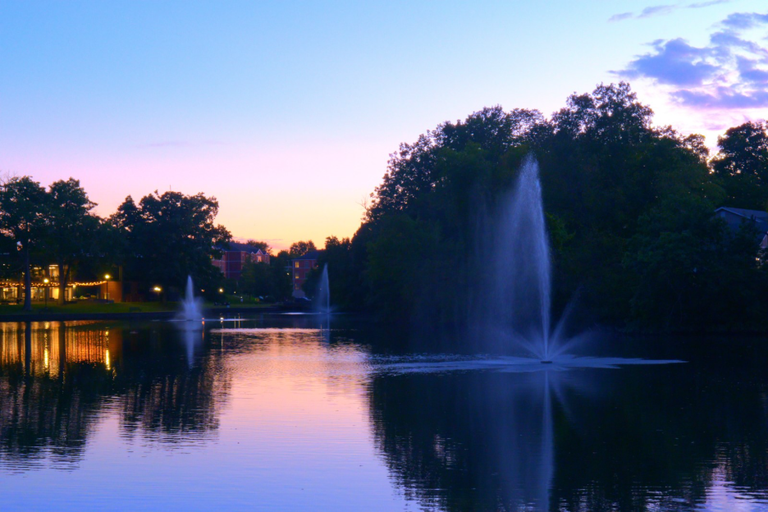
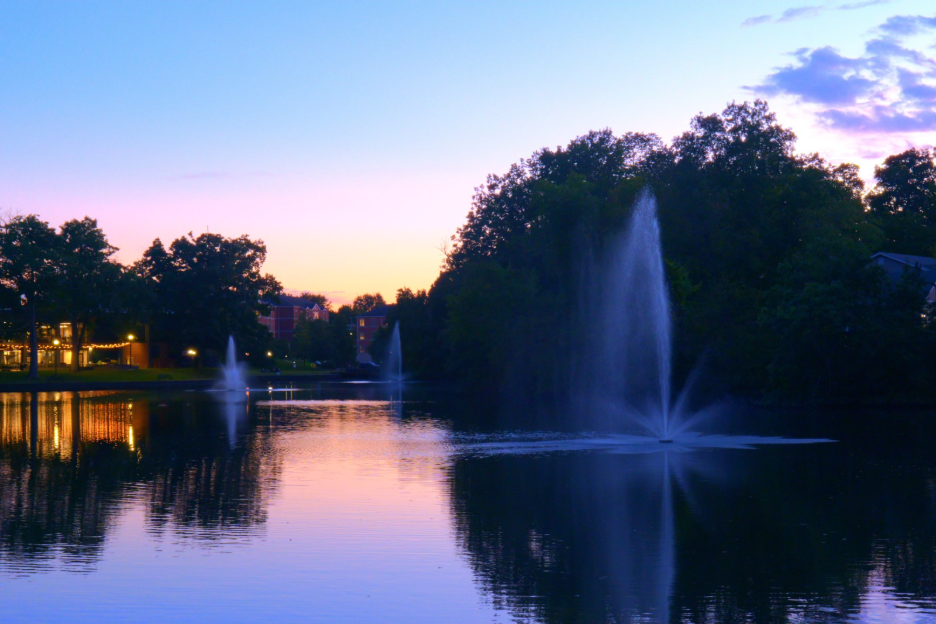
If you’ve ever strolled around Huntington University’s campus, you’ll know it’s impossible to miss its beautiful lake, with its fountains flowing into the glistening water. The eight-acre water feature is a highlight of the campus’ scenic beauty, but do you know how it came to be?
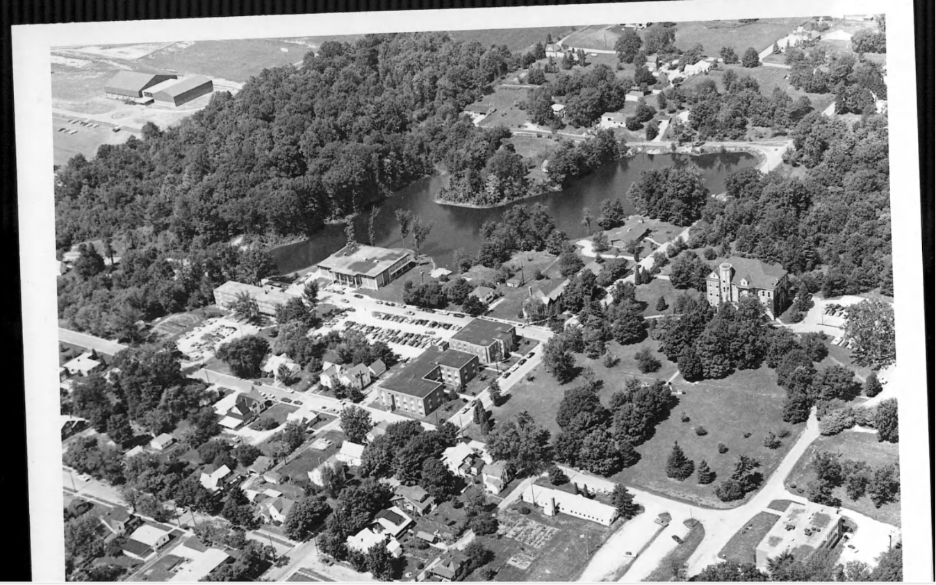
The plans for a lake date back to when the college was first being designed in 1896. Since the school was first established as Central College—with the only building being Central Hall, now Becker Hall—a lake was always in the plans.
Lake Sno-Tip was finally created in 1966. It all started with two men—Gene Snowden, a member of the Board of Trustees, and Floyd L. “Bill” Tipmore, Director of Public Relations and Development. Both Huntington College Foundation board members, the pair found the original plans, and upon seeing them, decided to finally construct the long-awaited lake.
Snowden and Tipmore were the engineers of the project, organizing the whole process. They arranged contractors, secured financial aid from local businesses, and donated their own time and labor to finish this ambitious undertaking.
However, the lake wouldn’t have been possible without the help of private enterprises, the local government, and volunteers from what was then Huntington College and the greater Huntington community. These groups contributed materials, such as tile and gravel, various equipment, and most importantly, labor. In all, the total monetary value of their contributions added up to around $20,000.
The construction of the lake began with Paul Blomeke, a contractor, who cleared out the 8 acres for the impoundment, and carved out the land to form a basin. The next step was to create a dam to fill it. Meanwhile, in Huntington, work was underway to build a bypass, U.S. 24, on the north end of town. A delay of the construction caused workers of the company, S.D. Solomon and Sons of Lansing, Michigan, to cease progress for a few days. So, President Baker asked the workers to build the Huntington College Lake Dam, and they volunteered.
Lake Sno-Tip’s measurements were far smaller than the original plans, which called for the lake to be 75 feet deep and ½ mile long. As a result of their dedication to the project, the lake was named for Snowden and Tipmore, a combination of their names. This name was suggested by the Development Secretary, Irene Swoverland.
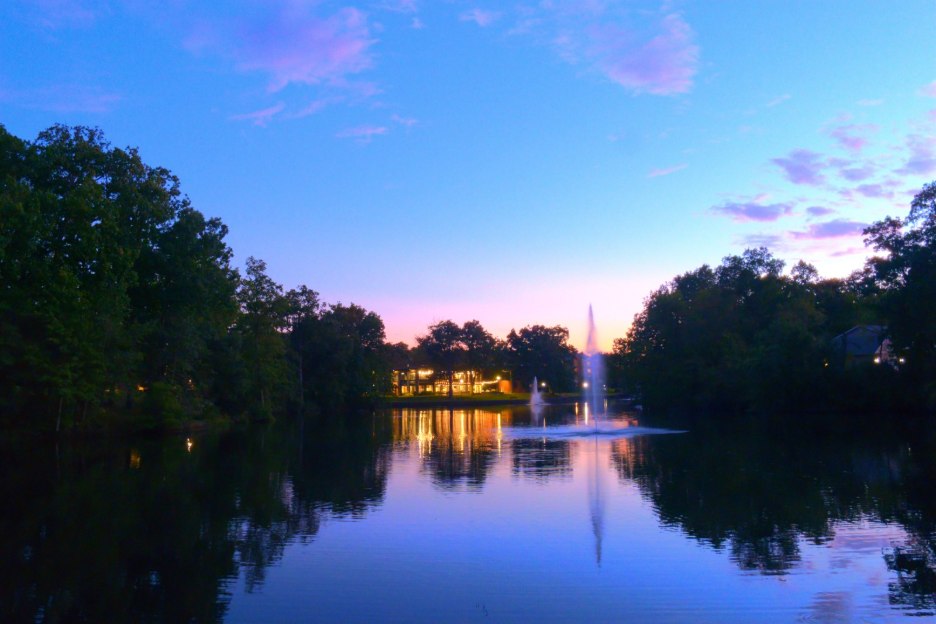
Since its creation, Lake Sno-Tip has been used for various activities. In the past, clean-ups took place around the lake, where volunteers cut trees and burned brush before winter. Many recreational activities took place on the lake, including ice skating and ice hockey in the winter, paddleboating, fishing, boating and sailing, and raft races during Homecoming and Parents’ Weekend.
I spoke with Randy Neuman, our archivist, and the source of the majority of this information.
Randy explained that these recreational activities were able to take place in the past “because the lake was a little bit shallower than it is now…so it froze a little more…,” ensuring the safety of the students.
“Mostly [they’ve] just deepened the lake, so the algae doesn’t grow like it used to,” Neuman says of the changes the lake has gone through over the years. He explained that the lake was deepened during the creation of the Dining Commons, and a geothermal unit was placed to allow cool air from the lake, whose temperature averages 50 degrees Fahrenheit, to flow into the Dining Commons, cooling it. Other changes in the lake since its initial construction include extensions, such as near the President’s house, and renovations to the dock. Neuman explained how in the past, the university has attempted to build a dock that extended farther into the lake, but unfortunately has been unable to retain one due to disrepair. In the past there were drainages, especially as a result of sewage issues and a need to restock the fish that live in water.
In 1967, some area around the lake was cleared for the creation of the Huntington Union Building (HUB), on Lake Street, which historically ran through the campus. Later, in 1986, the Richlyn Library was created, overlooking Lake Sno-Tip.
Besides recreational activities, the lake has been used for marine biology. I talked with Dr. Collin Hobbs, professor of Biology, about a study of the lake. In 2019, a student, Adrienne Funderburg, conducted a research project where she assessed the water quality of the lake and compared it to a study by a professor in 1977-1978. She found that the chemicals in the lake showed relatively preferable measurements, but due to the great amount of algae, Funderburg proposed the addition of fountains to manage it. In 2019, two alumni, Dr. Lars and Kathy Andersen, donated funds for two fountains to be added in addition to the first fountain, which would have ecological benefits.
Currently, the lake isn’t used primarily for recreational purposes, though incoming freshmen are able to enjoy kayaking during Finally Foresters weekend. It is cared for by a third-party maintenance. Marcie Nofziger, the director of maintenance, explained that the Aquatic Management in Bluffton is responsible for the lake’s algae control, maintains its fountains, and helps control the vegetation around its shores and walls. They are also responsible for dying it to make it more aesthetically pleasing than it would otherwise be with its natural, murky brown color. Fish such as smallmouth bass, bluegill, sunfish, catfish, and crappie call the lake home. Hammock stands and swings are also located around the lake, offering students a place to enjoy nature or study.
Lake Sno-Tip’s appearance and uses have changed over the years since its creation in 1966, but it continues to be a well-loved landmark and favorite feature of the Huntington University campus.